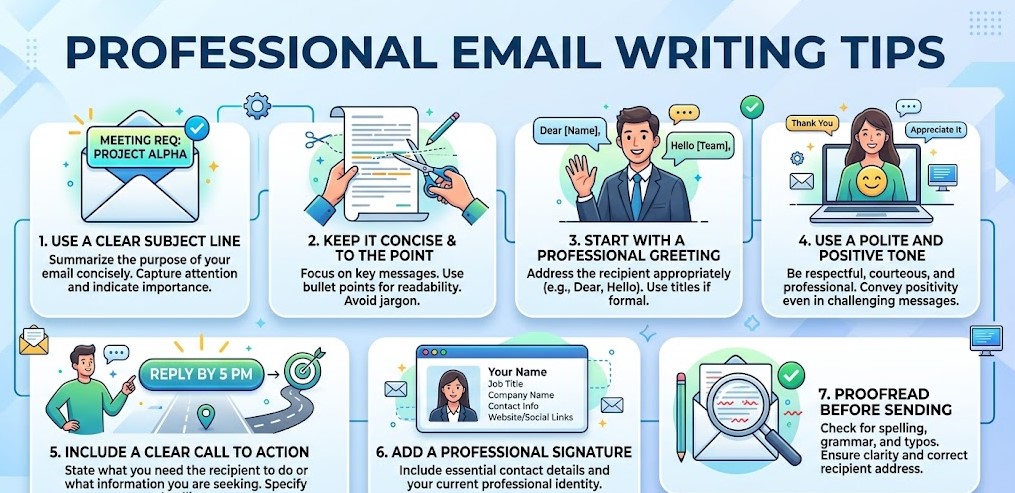
In today’s fast-paced digital workplace, understanding professional email writing tips is essential because email has become the backbone of business communication across industries. Whether you are coordinating with team members, communicating with clients, or sending updates to management, your email often creates the first impression of your professionalism and attention to detail. A well-written email not only conveys information clearly but also builds trust, reduces misunderstandings, and helps ensure that tasks are completed efficiently. On the other hand, poorly structured or unclear emails can lead to confusion, delays, and even damaged professional relationships. This is why mastering email communication is no longer optional—it is a core skill in modern workplaces where clarity, speed, and precision are highly valued.
Crafting Powerful and Clear Subject Lines
A strong subject line is one of the most important professional email writing tips because it determines whether your email gets opened immediately or ignored. In modern communication, people receive dozens or even hundreds of emails daily, so the subject line must quickly communicate purpose and urgency. A clear subject line should summarize the main intent of the email in just a few words, making it easy for the reader to understand what the message is about before even opening it.
An effective subject line is specific, direct, and action-oriented. For example, instead of writing “Meeting,” a better subject line would be “Project Meeting Scheduled for Monday at 10 AM.” This gives immediate clarity and sets expectations for the reader. Poor subject lines often lead to delayed responses or confusion, especially in busy work environments where people prioritize emails based on relevance. By applying professional email writing tips, such as avoiding vague wording and keeping subject lines concise, you significantly improve the chances of your email being read and acted upon quickly.
Structuring Emails for Maximum Clarity
One of the most important professional email writing tips is learning how to structure your email in a way that is easy to read and understand. A well-structured email guides the reader smoothly from the introduction to the main message and finally to the required action. Without proper structure, even a simple message can become confusing or overlooked. That’s why professionals always organize emails into clear sections: a greeting, a short introduction, the main body, and a closing statement.
A strong structure also improves readability and saves time for both the sender and the receiver. For example, starting with a brief context such as “I am writing to update you on…” helps the reader immediately understand the purpose. Then, the main message should be broken into short paragraphs or bullet points when necessary. This approach ensures that key details do not get lost in long blocks of text. Using professional email writing tips like logical flow and clear formatting makes your communication more effective and increases the chances of receiving a quick response.
Maintaining the Right Tone in Business Emails
Another essential part of professional email writing tips is using the correct tone, which directly influences how your message is received. In business communication, tone should always be respectful, neutral, and professional, regardless of whether the message is positive, negative, or neutral. A well-balanced tone helps maintain good relationships, avoids misunderstandings, and ensures that your message is taken seriously. If the tone is too casual, it may reduce credibility, while an overly strict tone can feel unfriendly or even aggressive.
Maintaining the right tone also depends on your audience and context. For example, writing to a senior manager or client requires a more formal approach compared to messaging a teammate you work closely with daily. However, in all cases, clarity and politeness should remain consistent. Simple phrases like “please,” “kindly,” and “thank you” can make a significant difference in how your message is perceived. By applying professional email writing tips, such as adjusting tone based on the recipient and avoiding emotional language, you ensure that your emails remain effective, respectful, and professional in every situation.
Writing with Clarity and Conciseness
Clarity and conciseness are at the heart of effective professional email writing tips because busy professionals rarely have time to read long or complicated messages. A clear email communicates its purpose in simple language without unnecessary words, while a concise email delivers all essential information without overwhelming the reader. The goal is to make your message easy to understand in just a few seconds so the recipient can quickly decide how to respond or act.
To achieve clarity, avoid complex sentences and technical jargon unless it is necessary for the audience. Instead of writing long explanations, focus on direct statements that explain what you need and why. Conciseness does not mean leaving out important details; it means removing repetition and filler words that do not add value. For example, instead of saying “I am writing this email to inform you about the upcoming meeting that will be held next week,” you can simply say “This email is to inform you about next week’s meeting.” Applying professional email writing tips like this improves readability, saves time, and increases response efficiency in workplace communication.
Common Email Writing Mistakes to Avoid
Avoiding errors is a critical part of professional email writing tips because even small mistakes can reduce credibility and create confusion in business communication. One of the most common mistakes is sending emails without proofreading, which can lead to spelling errors, grammar issues, or unclear sentences. These mistakes may seem minor, but they often create a negative impression, especially in formal or client-facing communication where attention to detail matters greatly.
Another frequent issue is writing overly long or unfocused emails. Many professionals include unnecessary details, making it harder for the reader to identify the main point. Similarly, using vague subject lines, ignoring tone, or forgetting to include a clear call-to-action can reduce the effectiveness of your message. Some people also misuse “Reply All” or send emails to the wrong recipients, which can cause confusion or privacy concerns. By following professional email writing tips such as proofreading, staying focused, and maintaining proper email etiquette, you can avoid these mistakes and ensure your communication remains clear, professional, and impactful.
Practical Email Templates and Examples
Using ready-made structures is one of the most useful professional email writing tips because it saves time and ensures consistency in communication. A well-designed email template helps you stay organized while still allowing flexibility to adjust content based on the situation. For example, a simple professional email often follows this structure: greeting, purpose statement, key details, and closing. This format works for most business situations such as meeting requests, updates, or follow-ups.
A basic example of a professional email could look like this: start with “Dear [Name],” followed by a short introduction such as “I hope you are doing well.” Then clearly state the purpose, for example, “I am writing to confirm our meeting scheduled for Friday at 3 PM.” After that, include any necessary details or instructions, and end with a polite closing like “Thank you for your time” or “Best regards.” Applying professional email writing tips through templates ensures your emails are structured, clear, and easy to understand, especially in fast-paced work environments where clarity and speed are essential.
Conclusion
Mastering professional email writing tips is essential for effective communication in today’s digital workplace. A well-written email not only shares information but also reflects your professionalism, clarity, and respect for others’ time. From crafting strong subject lines to maintaining the right tone and keeping messages concise, each element plays an important role in how your email is received and acted upon. When you consistently apply these practices, your communication becomes more efficient, misunderstandings reduce, and your professional image strengthens significantly.
Email writing is not just about grammar or structure—it is about delivering the right message in the clearest and most respectful way possible. By avoiding common mistakes, using proper formatting, and focusing on clarity, you can significantly improve your workplace communication and productivity. These professional email writing tips help you build better relationships and ensure your messages always achieve their intended purpose.
FAQs
1. What are professional email writing tips?
They are guidelines that help you write clear, structured, and effective business emails that improve communication and professionalism.
2. Why is email structure important?
A clear structure helps readers quickly understand the message and respond without confusion or delay.
3. How can I make my emails more professional?
Use a clear subject line, maintain a polite tone, keep messages concise, and always proofread before sending.
4. What is the biggest mistake in email writing?
One of the biggest mistakes is sending unclear or overly long emails that make it difficult for the reader to understand the main point.
For More Visit guideitfast.com