
If you’re learning algebra, geometry, or coordinate math, understanding how to find slope is one of the most essential skills you can master. Slope describes the steepness and direction of a line. It tells you how much a line rises or falls for every unit it moves horizontally. From middle school math classes to advanced calculus and physics applications, slope is a foundational concept that connects equations, graphs, and real-world measurements.
Educational standards from organizations like the National Council of Teachers of Mathematics emphasize slope as a core algebraic concept. Whether you are calculating the gradient of a line, interpreting a graph, or converting equations into slope-intercept form, knowing how to find slope accurately is critical.
In this comprehensive 3,000-word guide, you will learn:
- How to find slope with two points
- How to find slope on a graph
- How to find slope of a line
- How to find slope intercept form
Each section includes detailed explanations, structured build points, formulas, and examples to help you build strong mathematical confidence.
Understanding What Slope Means in Mathematics
Before diving into formulas, it’s important to clearly understand what slope represents conceptually. Slope measures the rate of change between two variables. In coordinate geometry, it tells us how steep a line is and whether it increases or decreases from left to right.
Core Concepts of Slope
• Slope as Rate of Change
Slope represents how much y changes when x increases by one unit. If y increases as x increases, the slope is positive. If y decreases as x increases, the slope is negative.
• Rise Over Run Definition
The most common definition of slope is “rise over run.” Rise refers to vertical change, and run refers to horizontal change.
• Positive, Negative, Zero, and Undefined Slopes
A positive slope rises upward. A negative slope falls downward. A horizontal line has zero slope. A vertical line has undefined slope because division by zero is not possible.
• Slope and Real-Life Applications
Engineers calculate road incline using slope. Economists measure growth rates. Scientists use slope to interpret experimental data.
• Connection to Linear Equations
Slope appears in linear equations like y = mx + b, where m represents slope.
• Visual Interpretation
Steeper lines have larger absolute slope values. Gentle lines have smaller slope values.
Understanding these fundamentals prepares you to confidently calculate slope in different scenarios.
Also Read:- How to Use Lifting Straps: The Complete Expert Guide for Strength and Safety
How to Find Slope with Two Points
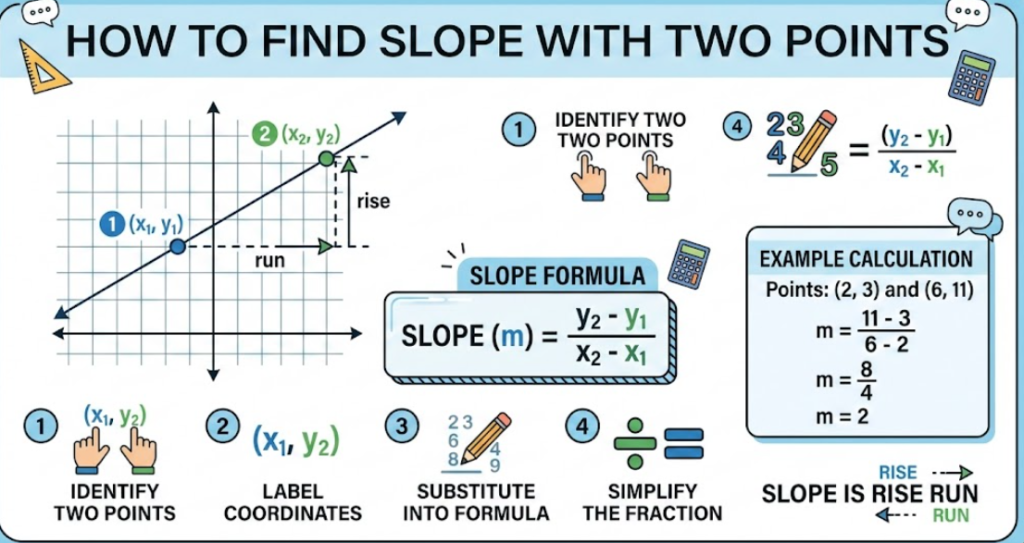
One of the most common algebra questions is how to find slope with two points. This method uses a simple formula derived from rise over run.
Step-by-Step Formula Application
• Use the Slope Formula
The formula for slope is:
m = (y₂ − y₁) / (x₂ − x₁)
This formula calculates vertical change divided by horizontal change.
• Identify Coordinates Clearly
Label your two points as (x₁, y₁) and (x₂, y₂). Consistency prevents calculation errors.
• Subtract Correctly
Subtract y-values first, then x-values. Maintain the same order in numerator and denominator.
• Avoid Sign Mistakes
Be careful with negative numbers. A small sign error changes the entire result.
• Example Calculation
If points are (2, 3) and (6, 11):
m = (11 − 3) / (6 − 2) = 8 / 4 = 2
• Interpret the Result
A slope of 2 means the line rises 2 units for every 1 unit moved right.
Mastering how to find slope with two points is essential for solving algebra problems efficiently.
Also Read:- How to Store Peaches: The Complete Freshness & Ripening Guide
How to Find Slope on a Graph
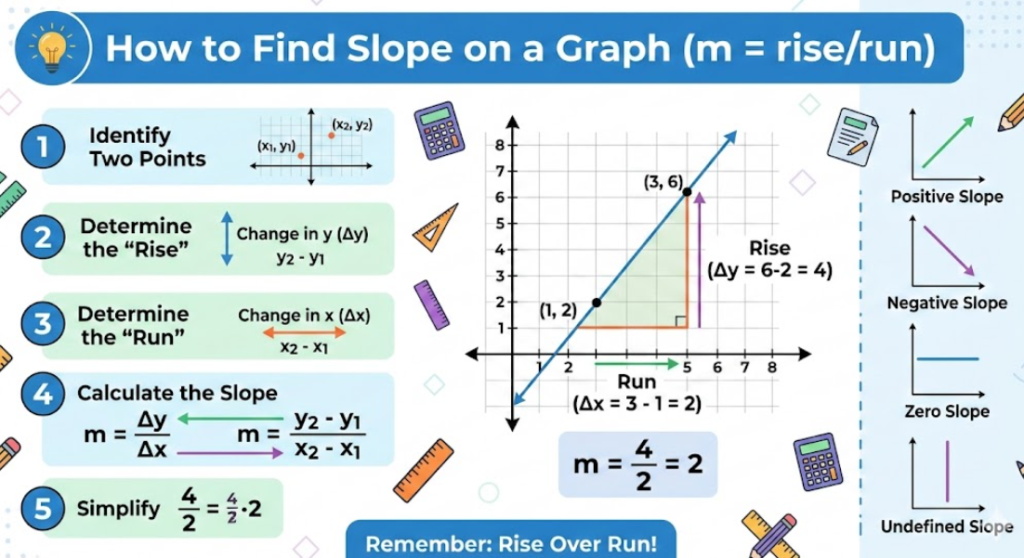
Sometimes slope must be calculated visually from a graph instead of given coordinates.
Visual Slope Calculation Method
• Identify Two Clear Points on the Line
Choose points where the line crosses grid intersections for easier reading.
• Count the Rise
Determine how many units the line moves up or down vertically.
• Count the Run
Determine how many units the line moves horizontally.
• Create a Fraction
Slope = rise/run.
• Check Direction
If the line goes upward left to right, slope is positive. Downward indicates negative slope.
• Double-Check Accuracy
Recount squares carefully to avoid misreading.
This method strengthens visual understanding and graph interpretation skills.
Also Read:- How to Start Composting – The Ultimate Beginner’s Guide
How to Find Slope of a Line from an Equation
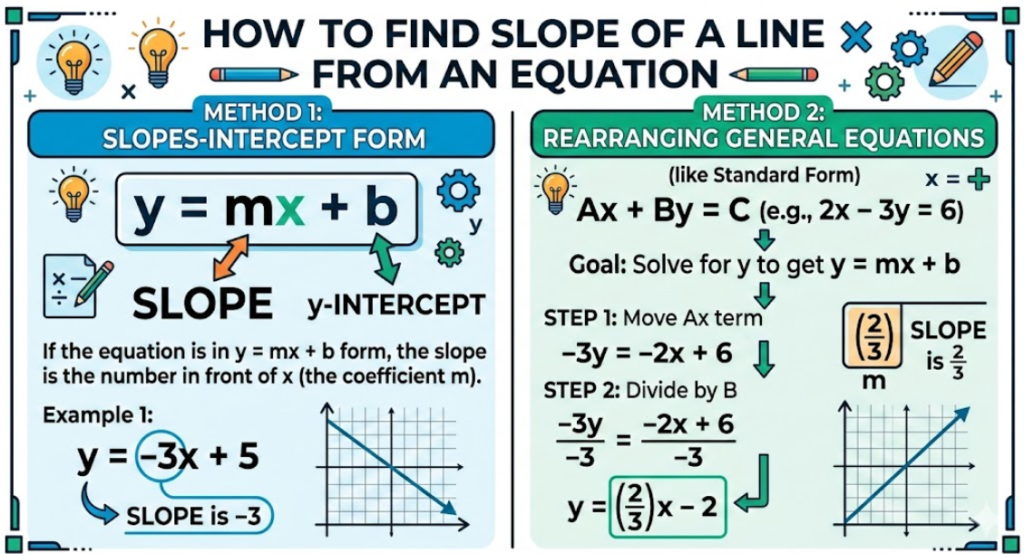
When a linear equation is provided, slope can often be identified directly.
Recognizing Slope in Different Equation Forms
• Slope-Intercept Form (y = mx + b)
The coefficient m is the slope.
• Standard Form (Ax + By = C)
Rearrange into slope-intercept form to identify slope.
• Point-Slope Form (y − y₁ = m(x − x₁))
The value m is already the slope.
• Horizontal Lines (y = constant)
Slope equals zero.
• Vertical Lines (x = constant)
Slope is undefined.
• Rewriting Equations Step-by-Step
Convert equations carefully to avoid algebra errors.
Recognizing equation structures speeds up slope identification significantly.
Also Read:- How to Type Degree Symbol (°) on Any Device – Complete Guide
How to Find Slope Intercept Form

Understanding how to find slope intercept form connects slope with graphing.
Converting to Slope-Intercept Form
• Start with Standard Form
Example: 2x + 3y = 12.
• Isolate y
Subtract 2x from both sides.
• Divide by Coefficient of y
y = -2/3x + 4.
• Identify m and b
Slope (m) = -2/3, y-intercept (b) = 4.
• Graph Using m and b
Plot the intercept first, then apply slope.
• Verify by Substitution
Test points to confirm accuracy.
This form simplifies graphing and equation analysis.
Also Read:- How to Make Obsidian in Minecraft: The Complete Expert Guide
Common Mistakes When Finding Slope
Even simple slope problems can lead to mistakes.
• Mixing coordinate order.
• Forgetting negative signs.
• Dividing incorrectly.
• Misreading graphs.
• Confusing vertical and horizontal lines.
• Skipping simplification steps.
Practicing carefully reduces these errors over time.
Also Read:- How to Dice an Onion: The Complete Step-by-Step Kitchen Guide
Conclusion
Learning how to find slope is a foundational math skill that applies across algebra, geometry, science, and economics. Whether you’re calculating slope with two points, reading a graph, identifying slope in an equation, or converting to slope-intercept form, the key is understanding rise over run and practicing consistently.
Slope measures rate of change and direction. Mastering it unlocks deeper mathematical concepts and strengthens analytical thinking. With regular practice and careful attention to detail, anyone can confidently calculate slope in any format.
FAQs
What is the easiest way to find slope?
Use the formula (y₂ − y₁) / (x₂ − x₁).
What does slope represent?
It represents the rate of change between two variables.
Why is slope undefined for vertical lines?
Because division by zero is mathematically undefined.
Is slope used in real life?
Yes. It is used in engineering, construction, economics, and data analysis.
For More Visit guideitfast.com